|
|
Hope of Israel Ministries (Ecclesia of YEHOVAH):
Nahum and the "Antichrist"
|
Nahum describes the battle of Armageddon and the deliverance of the Judahites in chapter 1, and the fall of end-time Nineveh in chapter 2. In an end-time context, Nineveh represents the future power-base of the end-time Islamic "Antichrist's" empire. |
by John D. Keyser
Nahum was a prophet to Judah, during the 7th century B.C., who prophesied the fall of Nineveh, the capital of the Assyrian Empire. About 100 years previously, Jonah had prophesied Nineveh's fall within 40 days, but YEHOVAH God gave the city a reprieve when they repented (Jonah 3-4). Nahum prophesied sometime after 663 B.C. (when Thebes fell, as mentioned in Nahum 3:8) and before 612 B.C. when Nineveh fell. Most likely it was also before 654 B.C. (when Thebes was rebuilt, which he does not mention), placing Nahum's ministry during the reign of Manasseh, son of Hezekiah. The northern kingdom of Israel had been conquered and exiled by the Assyrians in 722 B.C., when Hezekiah was king of Judah.
Hezekiah was forced to pay tribute to Assyria (2 Kings 18:13-14), but was delivered from Assyrian conquest when YEHOVAH God sent an angel that killed 185,000 Assyrian soldiers (2 Kings 19:35). Judah was still paying tribute to Assyria during the reign of Manasseh, for Nahum describes Judah as being under Assyria's yoke (1:13-15). Nahum was from Elkosh (1:1), a location that is unknown in Israel. An abandoned Israelite synagogue in Al Qosh in northern Iraq, about 25 miles north of ancient Nineveh, contains a tomb that is purported to be Nahum's tomb. If Elkosh equates with modern-day Al Qosh, it suggests that Nahum was one of the exiles from the northern kingdom, and prophesied to Judah from his place in exile.
Historical vs. Future Fulfillment
In the Dictionary of the Apostolic Church we find the following:
"The very earliest Messianic prophecies of the OT represent the Golden Age [the Millennium or Kingdom of YEHOVAH God] as preceded by a time of conflict -- the conflict which will destroy the particular oppressor of Israel at the time, and wipe out the ungodly in Israel itself. The power to be overcome is, in each case, an actually existing Empire -- Assyria, Babylon, or Persia -- whose downfall will immediately usher in the glorious reign of peace" ("Remnant," Vol. 2, p. 572).
Yet, in history, Assyria never defeated Judah and Jerusalem. The Golden Age has never yet followed the defeat of Assyria!
Many details of Nahum's prophecy were fulfilled historically when Nineveh fell in 612 B.C. to an alliance of Babylonians, Medes, Chaldeans, Persians, Scythians, and Cimmerians. However, some details suggest that Nahum's prophecy is ultimately a prophecy about the defeat of the Antichrist beast power, and the fall of his end-time empire. Firstly, according to Nahum 1:15, after the defeat of Assyria's king, described in 1:11 as "a wicked military strategist" (NET Bible), Judah will never again be invaded by "the wicked." Secondly, Nahum 2:2 says that YEHOVAH God will restore the majesty of Jacob and Israel. The restoration of the northern kingdom of Israel never occurred in history, but is prophesied in relation to the return of YEHOVAH God and His Messiah.
Also, the Antichrist beast power is called "the Assyrian" in Isaiah 10:5, 14:25, 30:31:
Isaiah 10:5: "Woe to Assyria, the rod of My anger, and the staff in whose hand is My indignation."
Isaiah 14:25: "That I will break the Assyrian in My land, and on the mountains tread him underfoot. Then his yoke shall be removed from them [YEHOVAH's people Israel], and his burden removed from their shoulders.
Isaiah 30:31: "For through the voice of the LORD Assyria will be beaten down, Who struck [them] with a rod."
Then, in Micah 5:5-7:
Micah 5:5-7: "And this One shall be peace. When the Assyrian comes into our land, and when he treads in our palaces, then we will raise against him seven shepherds and eight princely men. They shall waste with the sword the land of Assyria, and the land of Nimrod at its entrances; thus He [YEHOVAH God] shall deliver us from the Assyrian, when he comes into our land and when he treads within our borders. Then the remnant of Jacob shall be in the midst of many peoples..."
In Ezekiel 38 this Antichrist beast is called "Gog."
Ezekiel 38, which calls this Antichrist beast "Gog," indicates that he will come from Turkey -- much of which was historically part of the Assyrian Empire. A significant number of biblical scholars and historical sources place Gog and the land of Magog in regions corresponding to modern-day Turkey, particularly in Asia Minor, including areas like Lydia. This identification is based on biblical references, historical records, and geographical analysis of ancient peoples mentioned in Ezekiel and Genesis.
According to Daniel 7:24, the end-time empire will be formed initially as a coalition of ten rulers. Revelation 17 portrays this as a beast that is sat upon and controlled by Mystery Babylon, the Great Prostitute (Roman Catholic Church). This beast of Revelation 13:11 will be a resurrected Islamic Empire, probably created by Saudi Arabia (portrayed as Babylon in Isaiah 21) uniting a coalition of ten Arab nations. But according to Daniel 7:24, another ruler who is different to the other ten rulers, then rises to power over the beast, and is known in Revelation 19:20 as the "false prophet."
Psalm 83 also mentions these 10 kings of Islamic Arab nations:
Psalm 83:5-8: "For they have consulted together with one consent; they form a confederacy against you: The tents of Edom and the Ishmaelites; Moab and the Hagarites; Gebal, Ammon, and Amalek; Philistia with the inhabitants of Tyre; Assyria also has joined with them..."
This is the Islamic Antichrist who, figuratively speaking, unites the Babylonian and Assyrian Empires. He also creates an alliance with Iran (Ezekiel 38:5) which was also previously part of the Assyrian Empire. Also historically, the last king of the Babylonian empire was Nabonidus. Nabonidus was the son of an Assyrian priestess. He spent most of his reign in Arabia, where he worshipped Sin, the moon god. In Revelation, Mystery Babylon (the Roman Catholic Church) is destroyed in chapter 18, after the beast empire (Revelation 13:11) turns against her.
Revelation 17:16: "And the ten horns which you saw on the beast, these will hate the harlot [Catholic Church], make her desolate and naked, eat her flesh and burn her with fire."
The False Prophet and his beast empire subsequently fall in chapter 19 when YEHOVAH God defeats them at the battle of Armageddon. After the battle of Armageddon, it appears that YEHOVAH God will have some additional mopping up to do in nations that were part of the Islamic Antichrist's empire, including Lebanon (Isaiah 10:34), Egypt (Isaiah 19), Sudan, and Assyria including Nineveh (Zephaniah 2:12-13). At that time, the restored people of Israel will be involved in crushing remaining resistance in the surrounding nations and will expand the territories of Israel (Isaiah 26:15 and 54:3). They fight against Javan (Zechariah 9:12-15 -- Javan is western Turkey and possibly Greece), and they take territory from Gaza, the West Bank, Gilead on the east side of the Jordan, Jordan, and Saudi Arabia (Amos 9:12, Obadiah 1:17-20 and Zephaniah 2:4-9).
Amos 9:12: "'That they [Israel] may possess the remnant of Edom, and all the Gentiles who are called by My name,' says the LORD who does this thing."
Obadiah 1:17-18, 20: "'But on Mount Zion there shall be deliverance, and there shall be holiness; the house of Jacob shall possess their possessions. The house of Jacob shall be a fire, and the house of Joseph a flame; but the house of Esau [Edom] shall be stubble; they shall kindle them and devour them, and no survivor shall remain of the house of Esau,' for the LORD has spoken....And the captives of this host of the children of Israel shall possess the land of the Canaanites as far as Zarephath. The captives of Jerusalem who are in Sepharad shall possess the cities of the South."
It is therefore reasonable to understand Nahum as ultimately a prophecy about the fall of the Islamic Antichrist and his end-time empire.
Nahum 1
Nineveh is only mentioned in 1:1 and 3:7. At various other points in the book, the NET Bible adds "Nineveh" or "the Assyrians" for the sake of clarity, though they are not in the Hebrew text (e.g. vs. 8, 11, 13). Given that the Antichrist of Revelation 13:11 is figuratively called "the Assyrian" in various end-time prophecies, it suggests that, in an end-time context, Nineveh represents the political power-base of this Antichrist's empire. Given that the Antichrist may come from Turkey (Ezekiel 38:1), end-time "Nineveh" may be Ankara, the capital of modern-day Turkey. If not, it could be a city elsewhere within the boundaries of the ancient Assyrian Empire, which included much of Turkey and Iran. According to Revelation 13:2, "The dragon gave the beast his power, his throne, and great authority to rule".
The dragon in this portrayal is Satan, and the "beast" is the Islamic Antichrist's end-time empire. In the first century A.D., the Messiah described Satan's throne as being in the city of Pergamum in western Turkey, "To the angel of the church in Pergamum write…I know where you live -- where Satan’s throne is" (Revelation 2:13). The Messiah was referring to the Pergamum altar of Zeus. In the late 19th century, this was excavated by the German engineer, Carl Humann. Its western side was moved and reassembled in Berlin in the Pergamon Museum. In the 1930s, Hitler's stage for the Nuremberg Rallies was modeled on the Pergamum Altar.
It was as though Satan gave
Hitler his throne. Hitler was a type of antichrist, but not the final
Antichrist, just as the Apostle John wrote in 1 John 2:18, "Children, it is the
last hour, and just as you heard that the antichrist is coming, so now many
antichrists have appeared." In context of the final Antichrist and his
end-time empire, what does it mean that Satan will give the beast his throne? Is
Satan's throne still in Turkey? Time will tell.
In verses 2 to 3, Nahum introduces YEHOVAH as a zealous and vengeful God
who, though slow to anger, is great in power and will not allow the wicked to go
unpunished. From an end-time perspective, this sets the prophecy within the
context of the "Day of the LORD" or "Day of Vengeance." At his first appearance,
the Messiah announced the "Year of the LORD's favor" (Luke 4:19), a time period
we are still in when YEHOVAH God withholds His judgment, waiting for His people
Israel to
repent. At his second appearance, the Messiah will announce the "Day of
Vengeance" (Isaiah 61:2).
|
|
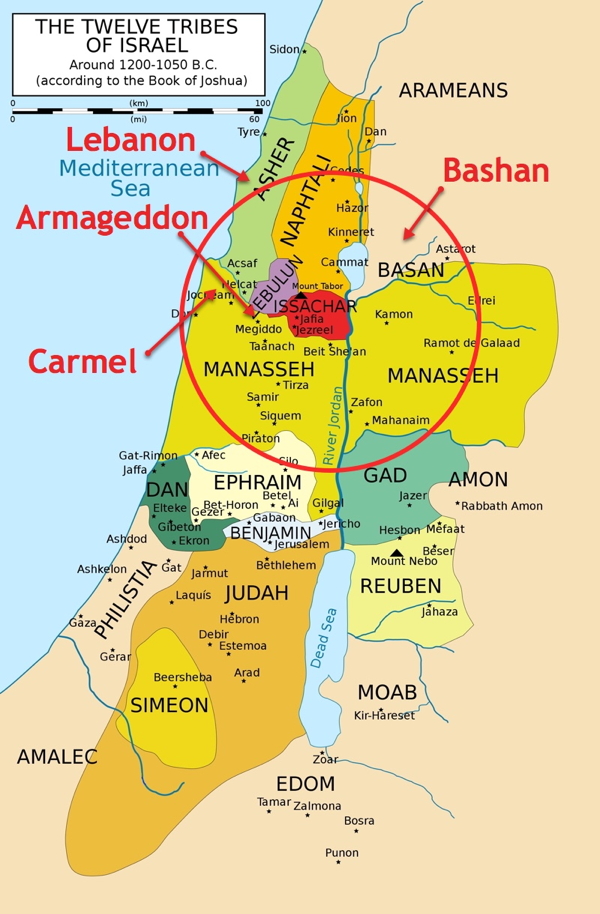
In verses 3b to 8, YEHOVAH God is portrayed as a mighty warrior arriving in northern Israel and laying waste to the earth and its inhabitants. The mention of Bashan, Carmel and Lebanon in verse 4 places this battle in the same vicinity as Megiddo, identifying this as the battle of Armageddon -- see map above. The battle of Armageddon is YEHOVAH God's final battle to defeat the Islamic Antichrist and his empire. Nahum uses similar language to other prophets who describe YEHOVAH's end-time campaigns (e.g., Psalm 97, Isaiah 10:5-34, 29:1-8, 33:1-14, Amos 1:2-15, Habakkuk 3:1-15). YEHOVAH God is portrayed using various weapons, including a raging storm, a battle cry, drying up the sea and rivers, fire, earthquake, and an overwhelming flood.
Verses 9 to 11 and 14 address the Antichrist, a wicked military strategist, who marches out against YEHOVAH God (v. 11). Whatever he plots against the LORD will be completely destroyed (v. 9). His armies will be burned up like entangled thorn bushes or dry stubble (v. 10). YEHOVAH has decreed an end to his dynasty, and to desecrate his grave because he is despised (v. 14). In ancient times, a proper burial was considered very important, and it was a great humiliation for someone's grave to be desecrated. So metaphorically, it implies that the Islamic Antichrist will be utterly humiliated. YEHOVAH God also promises to destroy the idols and images in the temples of his gods, indicating that YEHOVAH will also humiliate and destroy this Antichrist's religion. According to Daniel 11:38, this Antichrist will honor a god of fortresses. Together with the fact that he leads countries which today are all Muslim nations, he is certainly a Muslim. Verse 14 is therefore a prophecy of the fall of Islam.
Verse 9b may be a very significant statement regarding the Great Tribulation, "Distress (or trouble)" will not arise a second time. We should equate the "time of Jacob's trouble" with the end-time events rather than with the Great Tribulation that occurred in 70 A.D. The "time of Jacob's trouble" will be a time of great trouble for YEHOVAH God's people Israel. Israel will experience YEHOVAH's severe discipline during Jerusalem's conquest by the Islamic Antichrist, but the Great Tribulation was in the past and it is hard to imagine YEHOVAH God allowing a repeat of the siege of Jerusalem and the destruction of the Temple by the armies of Rome.
Verses 12, 13 and 15 address Judah. YEHOVAH God tells Judah that even though Islam's armies are large and powerful, they will be destroyed (v. 12). YEHOVAH says He afflicted Judah, but will do so no more (v. 12b). This suggests that YEHOVAH God first allows this Antichrist power to invade and occupy lands modern Israel is scattered to in order to discipline her in due measure as in Jeremiah 30:11.
Jeremiah 30:11: "'For I am with you,' says the LORD, 'to save you; though I make a full end of all nations where I have scattered you, yet I will not make a complete end of you. But I will correct you in justice, and will not let you go altogether unpunished.'"
In 2:2, Nahum says that enemies will have plundered these countries or lands of Israel and destroyed her fields. But now, YEHOVAH God will break this Antichrist's yoke from her neck and tear apart her shackles (v. 13). Judah will be delivered and never be invaded by the wicked again (literally "the wicked one" -- the NET Bible's insertion of "Assyrians" is not in the Hebrew text). This is a picture of Millennial peace and security for YEHOVAH's people Israel (v. 15).
Nahum 2
In chapter 2, Nahum warns the
people of Nineveh that she is about to be attacked. An enemy who will scatter
her is marching out to attack her (v. 1). This enemy is identified in verse
13 as "the LORD who commands armies" (YEHOVAH God). YEHOVAH attacks Nineveh
in order to restore the majesty of Jacob and Israel. This is a picture of
Israel's Millennial restoration under the rule of King Yeshua, like Israel's
golden age under the rule of King David. Nineveh, in this context, represents
the power-base of the Islamic Antichrist's empire.
Verses 3 to 10 graphically portray the sacking of Nineveh. Verse 3
describes her attackers as having shields dyed red and wearing red garments. In
its historical fulfillment, this likely describes the uniforms of the Babylonian
soldiers (Ezekiel 23:14). In its end-time context, this may have another
significance and be an important clue that this battle occurs after the battle
of Armageddon, which Nahum described in chapter 1.
According to Revelation 19:13-15, when YEHOVAH God arrives at the battle of Armageddon, His royal robes are stained red. This is because they are splattered with the blood of His enemies whom He has slaughtered in His preceding campaign against Edom (Isaiah 63:1-3). It is clear in Isaiah 63:3-5 that YEHOVAH fights alone against Edom, but various prophecies indicate that after His Edom campaign, YEHOVAH God will muster an army to fight alongside Him at the battle of Armageddon (e.g., Psalm 149, Isaiah 13:1-6, Micah 4:11-13, Joel 2).
This army likely comprises
Israelites whom He liberates from captivity during His Edom campaign (Micah
2:12-13 and 4:10-13), in the "Bozrah breakout." It may also include resurrected
Christians (Psalm 50:1-5, 1 Thessalonians 4:13-18, Revelation 19:14). Revelation
19:13-14 says, "He is dressed in clothing dipped in blood, and He is called the
Word of God. The armies that are in heaven, dressed in white, clean, fine linen,
were following Him on white horses." The fact that His armies arrive in "clean"
clothing suggests that Armageddon is their first battle. Here in chapter 2,
Nahum's description of YEHOVAH's warriors with shields and garments that are
dyed red (like those of YEHOVAH God) suggests this is a later battle. They are
dyed red with the blood of those they slaughtered at Armageddon.
Verse 4 describes the chariots of YEHOVAH's army that look like lighting
bolts and dash here and there like flashes of lightning. These are no normal
chariots, but advanced modern weapons of war. As they advance, the sluice gates
are opened and the city is flooded (v. 6). This was fulfilled when Nineveh was
sacked by the Babylonians in 612 B.C. The River Khosr ran through the city, and
the Babylonians attacked when it was in flood, using it as part of their
military strategy. Perhaps there will also be some kind of fulfillment of this
detail in relation to the end-time fall of "Nineveh." After Nineveh falls, its
people flee, or are taken into exile (v. 7-8), the city's treasures are
plundered, and the city is destroyed (v. 9-10). Nineveh is taunted in verses 11
to 12, and YEHOVAH God affirms that she will be destroyed in verse 13.
Nahum 3
Verse 1 gives four reasons for YEHOVAH's judgment of Nineveh: Her bloodshed, lies, plundering, and hoarding -- a perfect description of Islam down through the ages. The extent of her destruction is portrayed in verses 2 to 3. The slain will be gathered into piles but will be so numerous that people will still stumble over their corpses. In verses 4 to 7, YEHOVAH God likens Nineveh to a prostitute who seduces people with sorcery and enslaves them with her harlotry. She is stripped and publicly humiliated, with no-one to lament or comfort her. Metaphorically, the Bible portrays cities that worship idols of false gods as prostitutes (Ezekiel 23:30).
In Ezekiel 23, YEHOVAH God likened ancient Samaria and Jerusalem to two virgins who became prostitutes because they turned from YEHOVAH God, their Husband, to worship the idols of the surrounding nations. In Isaiah 47, Babylon is addressed sarcastically as "Virgin daughter Babylon." Revelation 17 picks up on this portrayal, and portrays the end-time Roman Catholic Church as Mystery Babylon, the Great Prostitute. End-time Catholicism fits this biblical portrayal because she seduces people to worship a false god.
The portrayal of end-time Nineveh as a prostitute suggests that the Islamic
Antichrist will similarly try to make people worship Allah. Nineveh's
humiliation in verses 5 to 7 suggests not just the humiliation of her people,
but also of her false god.
The description of the fall of the Egyptian city of Thebes in verses 8 to 11,
without mention of her rebuilding, helps date the Book of Nahum between 663 and
654 B.C. Nahum referenced the fall of Thebes in order to convince historic
Nineveh that she too would fall, despite her apparent strength and that of her
allies. In the end-time context, perhaps YEHOVAH's defeat of Egypt (Isaiah 19)
will precede His destruction of end-time Nineveh. Verses 12 to 15 describe
Nineveh under siege. Despite the efforts of her warriors, she will be destroyed
and burned. She will be devoured like crops are devoured by a locust swarm (v.
15). Nahum then turns this metaphor around and likens Nineveh's merchants and
officials to a swarm of locusts.
About 900 years before the apostle John’s Revelation, the
Prophet Joel has symbolically described an invading, attacking army as a swarm
of locusts. Any large, invading army might be compared to a swarm of locusts,
but the Arabs and Muhammad have a unique connection to the locust: “In the Bedoween romance Antar, the locust is introduced as the national emblem
of the Ishmaelites (one of the ancestors of the Arabs). And it is a remarkable
coincidence that Muslim tradition speaks of locusts having dropped into the
hands of Muhammad, bearing on their wings this inscription -- 'We are the army
of the Great God.'" When the sun rises they fly away and no-one knows where (v.
17). Nahum's point is that all Nineveh's merchants and officials will vanish.
Verses 18 to 19 are a concluding dirge affirming Nineveh's inevitable fall. Her
shepherds (leaders) are sleeping, and her sheep (her people) will be scattered
on the mountains (among the kingdoms) with no-one to re-gather them. All who
hear about her demise will rejoice because no-one escaped her endless cruelty
(v. 19). Historical records confirm that the ancient Assyrians were
particularly cruel. It is likely that the Islamic Antichrist will
demonstrate similar cruelty during Jacob's Trouble.
We have dealt with a fraction of the biblical material relating to the great end-time Islamic beast. The books of Habakkuk, Micah, Isaiah, Zechariah, and Zephaniah contain references to an end-time Assyrian tyrant also. The sheer volume of the biblical data suggests that the subject is of the utmost importance. We should remember that during the awful reign of the Islamic Antichrist "those who have insight will give understanding to many" (Daniel 11:33; cp. Daniel 12:3 and Isaiah 53:11).
|
Hope of Israel Ministries -- Paving the Way for the Return of YEHOVAH God and His Messiah! |
|
Hope of
Israel Ministries |
|
Scan with your Smartphone for more information |